How Cohen & Cohen Law made digital a major collections channel
Cohen & Cohen Law, LLC is a consumer debt collection firm based in New York City, that provides services across New York, New Jersey, and Connecticut. The firm manages consumer debt accounts throughout the entire legal lifecycle, handling a range of legal statuses including pre-suit, active suit, and post-judgment stages.
The problem with how collections usually works
Collections often suffer from fragmentation: email, SMS, and payment portals operate in silos. Without a cohesive strategy, firms are left "blasting" inventory with generic campaigns, guessing what works rather than using data to drive engagement.
Efficient recovery demands a unified, intelligent pipeline that bridges the entire legal lifecycle, from pre-suit through post-judgment. You need an all-encompassing platform where outreach is dynamically synchronized with portal activity to create a frictionless self-service path.
Score first, then work the account
Two products run the account in sequence. proCollect decides and executes and proPay collects. Treatment is uniquely orchestrated for each consumer by synthesizing legal stages, behavioral patterns, and past interaction history. This allows the system to adjust dynamically to how a consumer responds, ensuring the right message reaches them at the right time regardless of whether they are pre-suit or in active litigation. proPay is the payment portal where the consumer resolves the account, offering options to pay in full, make one-time payments, settle balances, or set up payment plans.
Because these two products share the same intelligence, every interaction is a direct continuation of the last—ensuring the consumer is always met with the most relevant next step.
A head-to-head test, not a before-and-after
Recovery numbers can move for dozens of reasons, which makes before-and-after comparisons unreliable. So Cohen & Cohen Law ran a head-to-head test instead: about 6,000 accounts were split at random into a digital group, worked through Prodigal, and a non-digital group, worked the firm's existing way, over the same period. Same accounts, same window, the only difference was the approach. That removed the guesswork from vendor selection and set a clear, verifiable performance baseline.
4.3x amount recovered, digital vs non-digital
4x recovery rate, digital vs non-digital
3x consumers on plans, digital vs non-digital
Pilot window Oct 8, 2025 – Jan 5, 2026 · ~6,000 accounts split at random between digital and non-digital
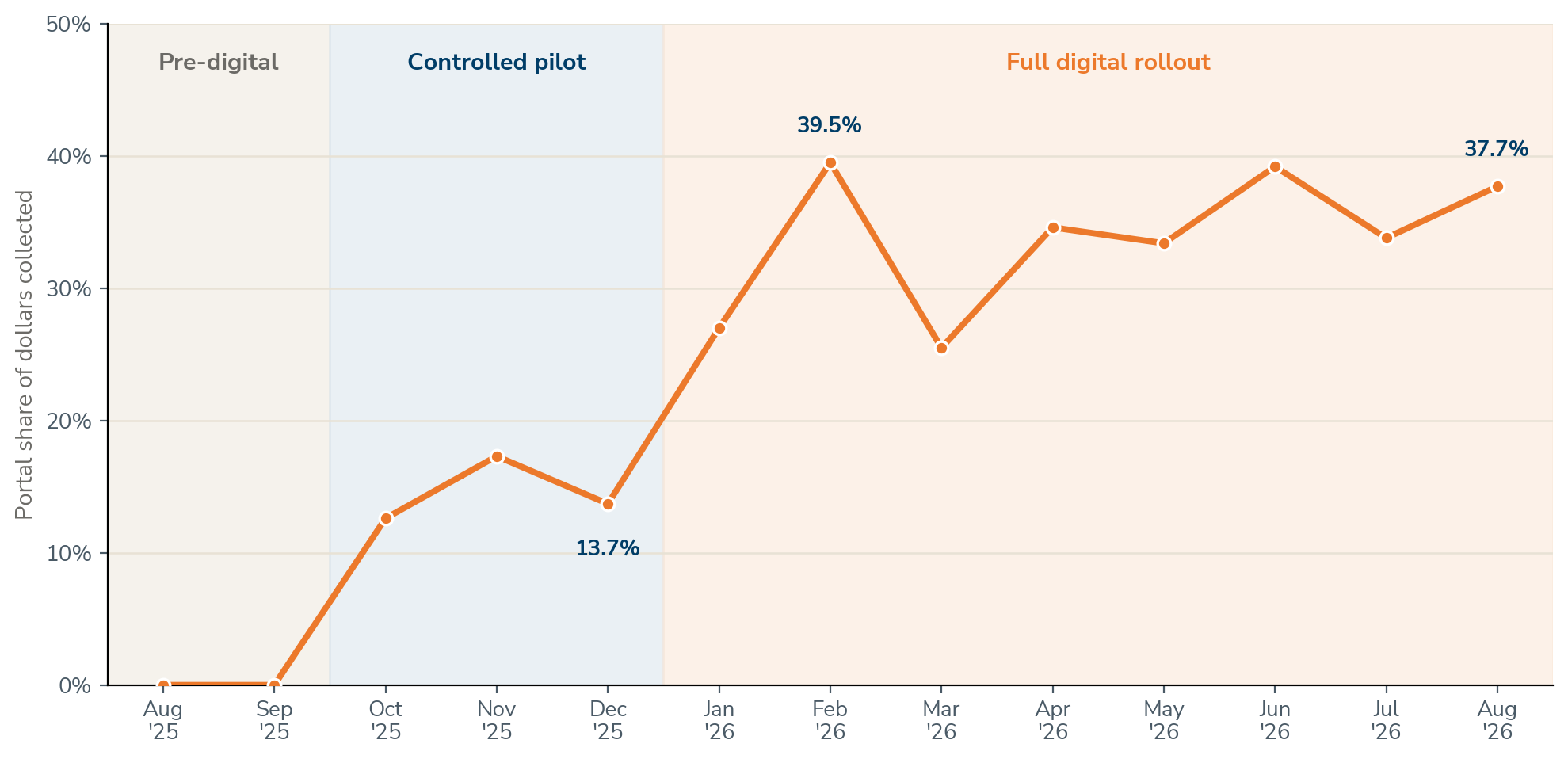
Portal payments grew from zero to nearly 40% of dollars collected
The steady climb in portal payments was driven by the cohesive handoff between proCollect and proPay. proCollect delivers intelligent, targeted outreach that meets consumers where they are, while proPay provides the intuitive environment to complete the resolution. From a standing start, this strategy grew portal payments to nearly 40% of every dollar collected within months of full rollout. When outreach is aimed well, consumers resolve their accounts on their own.
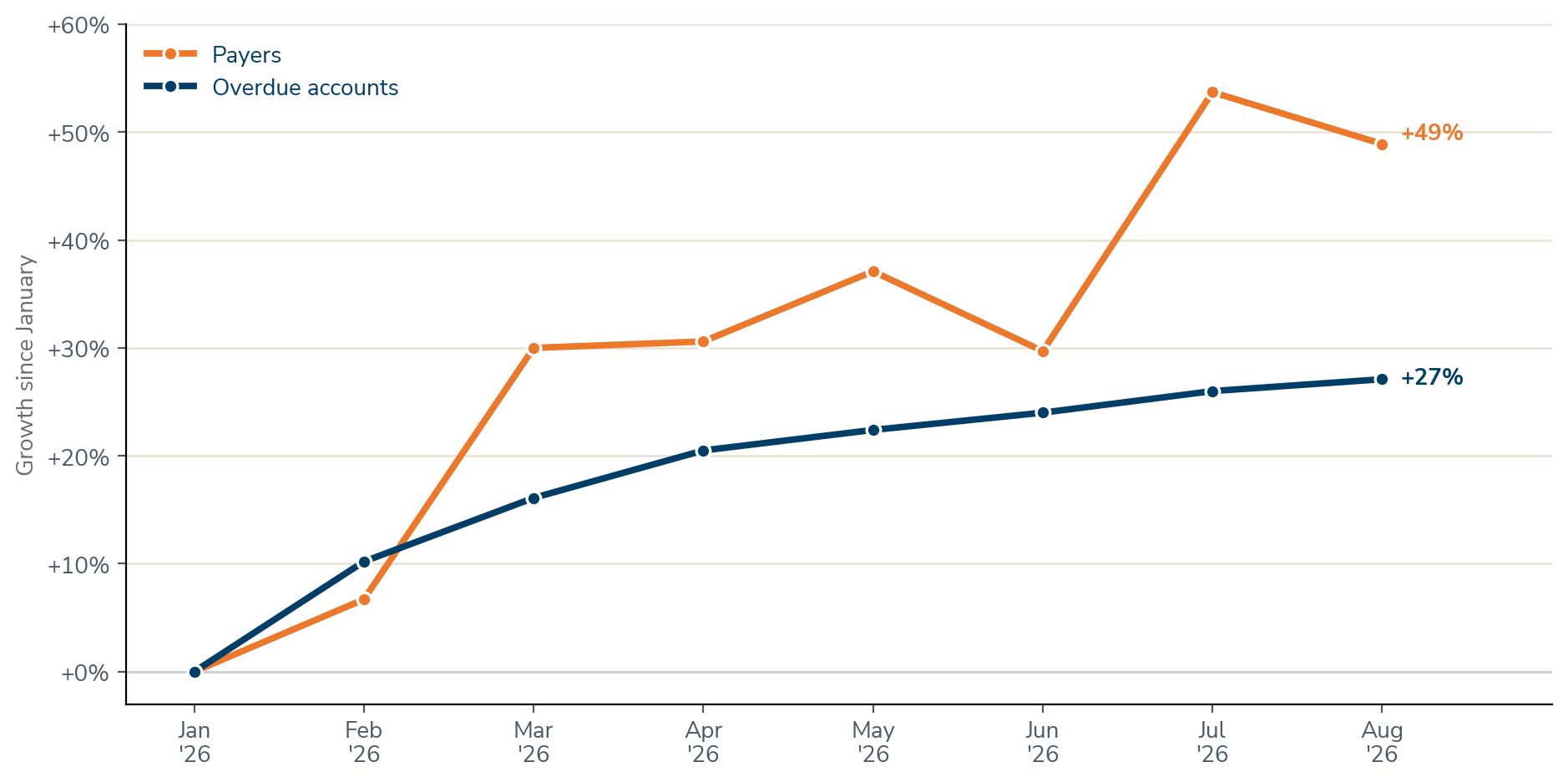
Converting more of a growing book
Despite the overdue book growing by more than a quarter between January and August, the program’s conversion rate actually improved. Typically, a larger book results in a smaller share of payments as new accounts pile up, but here, the payment rate rose alongside portfolio growth; proving that our automated sequence scales without sacrificing efficiency.
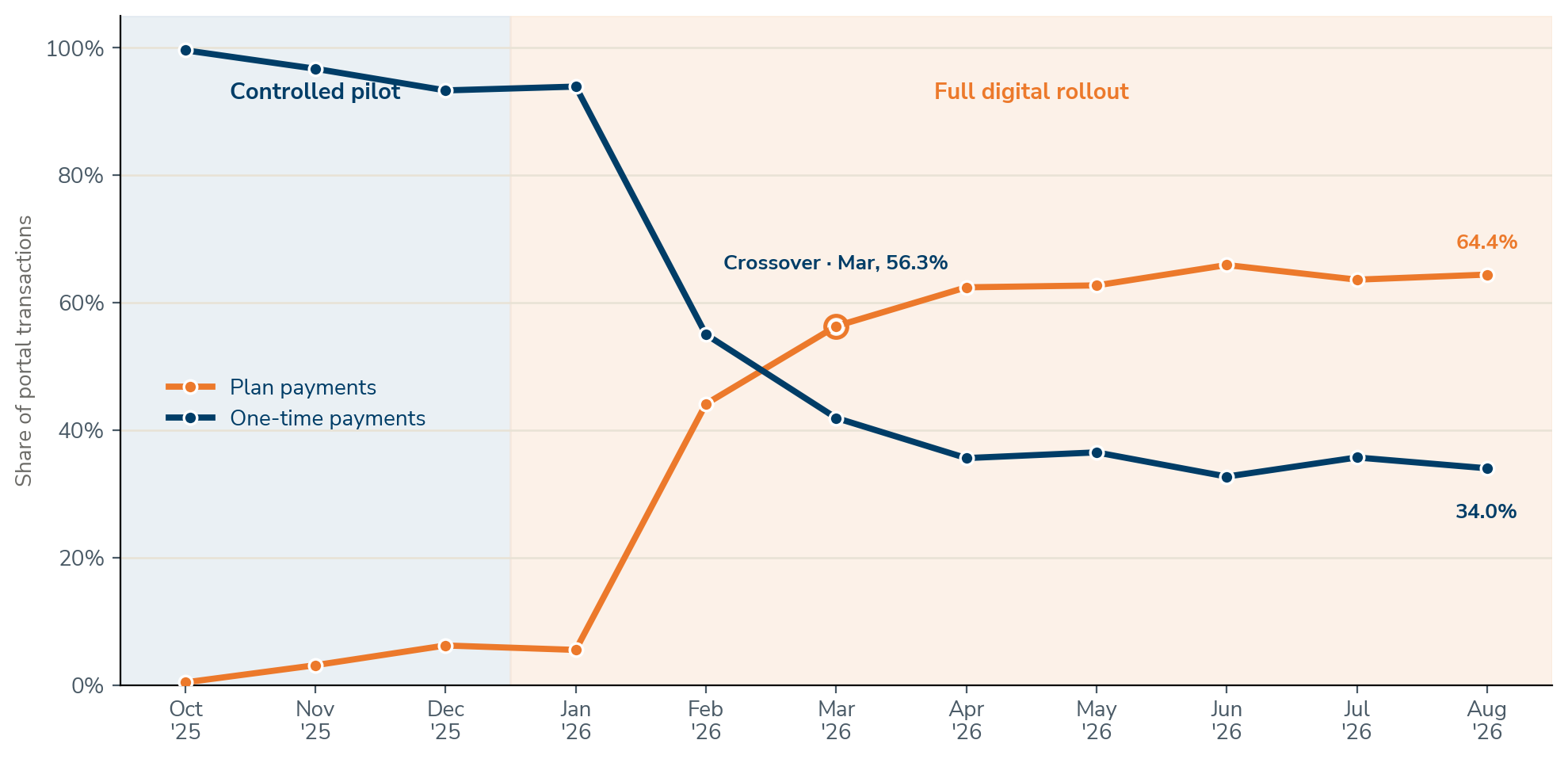
Payment plans overtook one-time payments
The portal opened as a way to take a single payment. A consumer logged in, paid once, and left. Through the pilot, almost every portal transaction worked that way, with plans close to zero. Within two months of full rollout, that flipped: by March, plans passed one-time payments, and by summer close to two in three portal transactions were a scheduled plan payment.
The pattern holds because the two build differently. One-time volume is capped by how many consumers engage each month, so it stays level. Plans accumulate: each month's enrollments keep contributing alongside earlier ones, as long as consumers stay on track. That base builds while one-time volume stays flat, which is why plan share climbs and then holds in the low-to-mid 60s.
That shift changes what the committed pipeline can be worth. Plans that stay on track collect on their own schedule, with less outreach behind them.
Outreach that lands
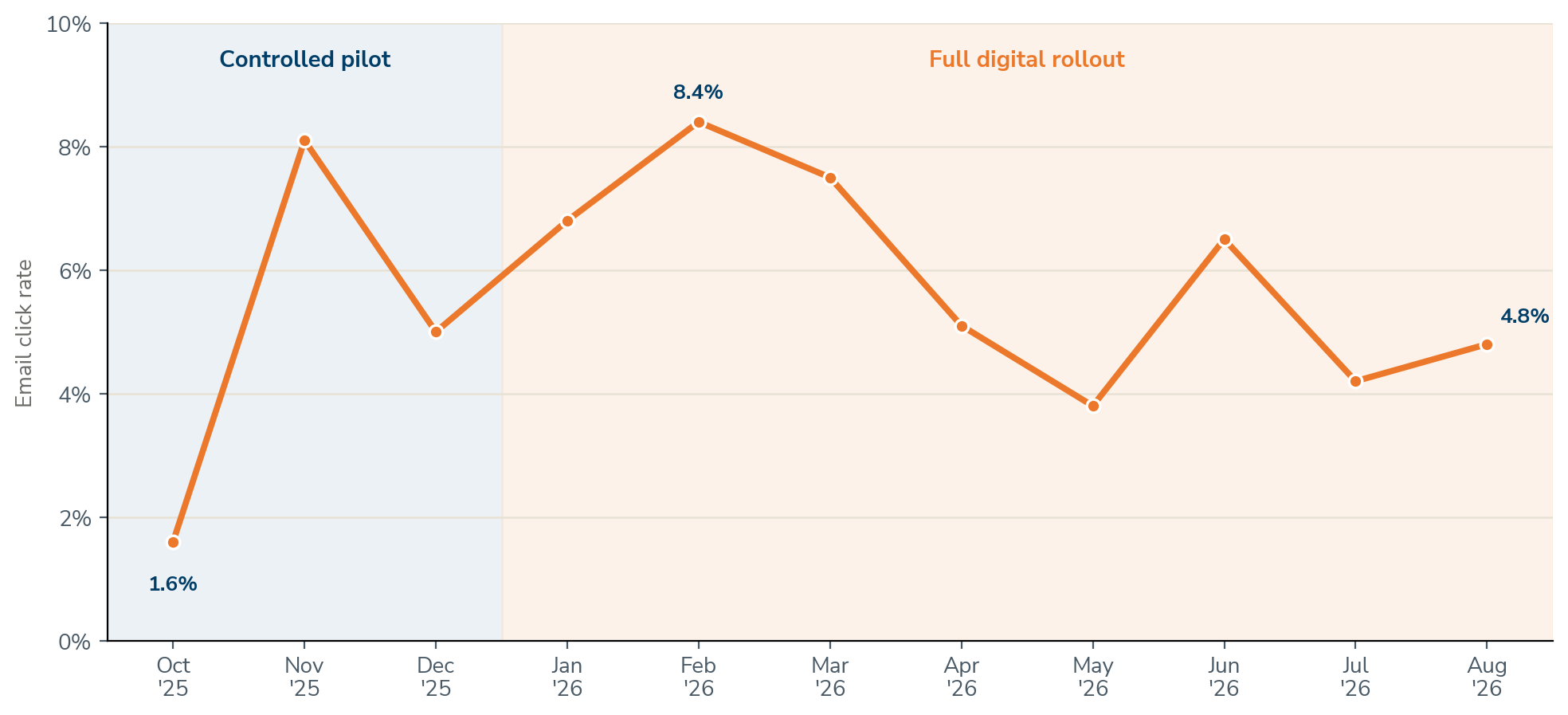
Email performance started with deliverability. Prodigal managed domain reputation and kept contact lists clean, which held delivery above 99% throughout. That same discipline on sender reputation and send timing kept open rates in the low-to-mid 50s across every month of the program. Once an account opened, personalized templates matched to where the consumer sat in the process did the rest, holding click rates in the mid-single digits, well above the 2 to 3% typical of email campaigns.
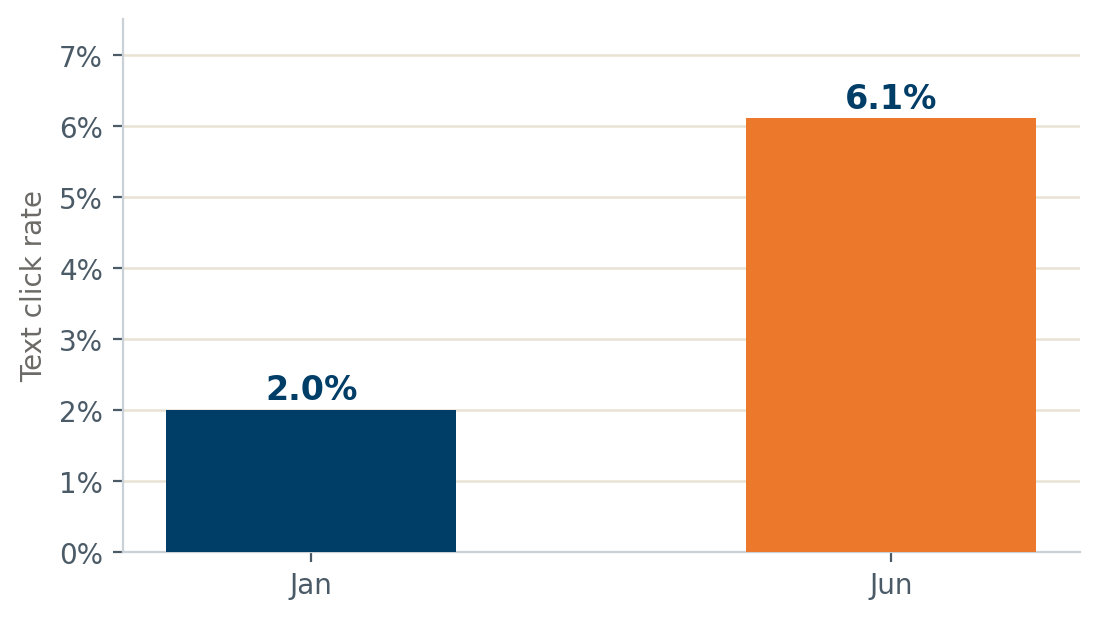
Text click rate tripled as contact data improved
Text needed more hands-on tuning than email. Prodigal cleaned up contact data and reworked the message templates as engagement data came in, learning which messages landed and rolling those out across the book. Click rates roughly tripled over the six months. The next step is MMS, going live now to push text performance further.
Building a compounding recovery pipeline
Payment plans are the engine of compounding recovery, turning a single digital contact into a predictable stream of future revenue without requiring agent time. Because our ecosystem creates plans at a steady, consistent pace rather than a one-time burst, the cumulative pipeline of scheduled payments has grown aggressively month-over-month. This steady accumulation ensures that the value of the digital program continues to compound over time, building a lasting foundation of scheduled recovery that strengthens with every month of operation.
Find out which of your accounts can resolve on their own
Prodigal will run the same controlled pilot against a held-back control group on your own accounts.




.png)
.webp)
.webp)














.jpg)
.jpg)





.jpg)


.webp)
.webp)


.webp)


-min.avif)


.avif)


-modified.avif)


.avif)


.svg)